
WE’RE VOTING UNION YES!
Voting “yes” to form a union will allow us, as Graduate Workers of Saint Louis University, to bargain collectively with the SLU administration for the first time. With a union, the SLU administration will have a legal obligation to negotiate with our elected representatives over pay, benefits, and workplace protections, and to secure any agreements on improvements or maintaining current benefits in a legally binding and enforceable contract.
With a union, the Graduate Workers of Saint Louis University Union (GWSLU Union-UAW) will represent all graduate student workers who have teaching and research responsibilities through their graduate assistantships or fellowships. Every graduate worker within our bargaining unit will be able to participate in the bargaining process through surveys, town halls, bargaining updates, and more. Every graduate worker will have the opportunity to vote on whether or not to ratify any proposed contract before it goes into effect.
Unionization is consistent with the larger moral mission of Saint Louis University. Catholic teachings emphasize the importance of the dignity of work, the moral obligations of employers and the right of workers to organize and advocate for themselves and their families.
“In many cases, poverty results from a violation of the dignity of human work, either because work opportunities are limited (through unemployment or underemployment), or ‘because a low value is put on work and the rights that flow from it, especially the right to a just wage and to the personal security of the worker and his or her family’.”
– Pope Benedict XVI, Charity in Truth [Caritas in Veritate], no. 63
Through thousands of conversations, graduate workers have expressed struggles with earning less than a living wage, poor dental and healthcare benefits, discrimination and abusive conduct, and a lack of protections and support for international students. These challenges add to the stress experienced by graduate employees and exacerbates inequities in higher education.
Right now, the SLU administration unilaterally decides if, when, and how to address challenges faced by graduate workers. With collective bargaining, we can meet at the bargaining table as equals. With strong participation and support from the entire graduate worker community, we can bargain a union contract that better meets our needs.
Over 100,000 other academic employees – including graduate employees, postdocs, research scientists, and adjunct faculty – also have chosen to bargain collectively and join UAW. Together, this movement is leading to rapid improvements in higher education like higher wages; improved healthcare benefits; protections from discrimination, sexual harassment, and abusive conduct; better job security, parental leave and childcare support; and more support for international scholars.
Vote “Union Yes” to bargain collectively and to decide democratically what is important for us at SLU, so that we continue to make working in higher education better for everyone.
Stronger protections against bullying, discrimination, and abusive conduct
Discrimination, harassment, and abusive conduct is too common in higher education. A recent survey conducted by Nature found that 1 in 5 grad students faced gender or racial-based discrimination, and another study found that early-career researchers from abroad are more likely to be threatened with termination.
This behavior is unacceptable. By forming a union, we can negotiate for strong, survivor-centered protections and hold SLU accountable. At other major research universities like UCLA, the University of Washington, Harvard, and Columbia, graduate employee unions have won strong protections like enforceable timelines, union representation, protection from retaliation, and the option to appeal to a neutral third-party arbitrator for cases of harassment, discrimination, and abusive conduct. With a union, we have more power to be heard, to determine our right to a safe and healthy workplace, and to ensure that our rights are enforced.
Learn more about how UAW academic workers are winning meaningful protections against discrimination, harassment and abuse:
Op-Ed: We’re Forming a Union to Create a More Equitable USC
Inside Higher Ed: At Long Last: A Contract for Columbia Student Workers
Elite Daily: UConn Graduate Student Union Helps Handle Sexual Harassment
Medium: UC International Postdoc Takes on Pregnancy Discrimination and Wins
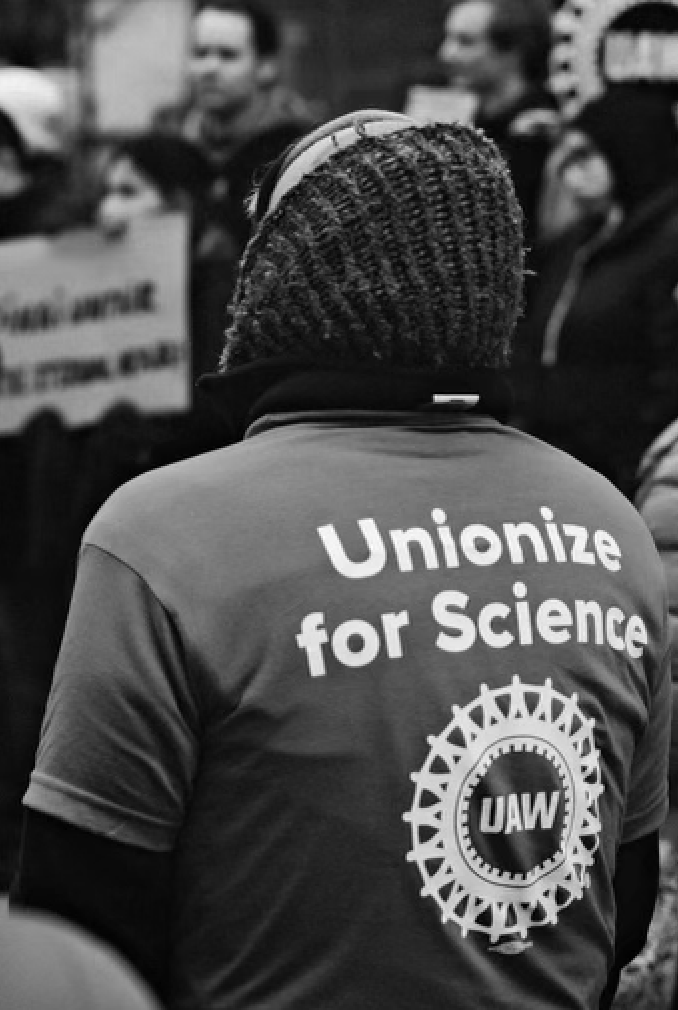
Sinai Postdoctoral Organizing Committee Rally
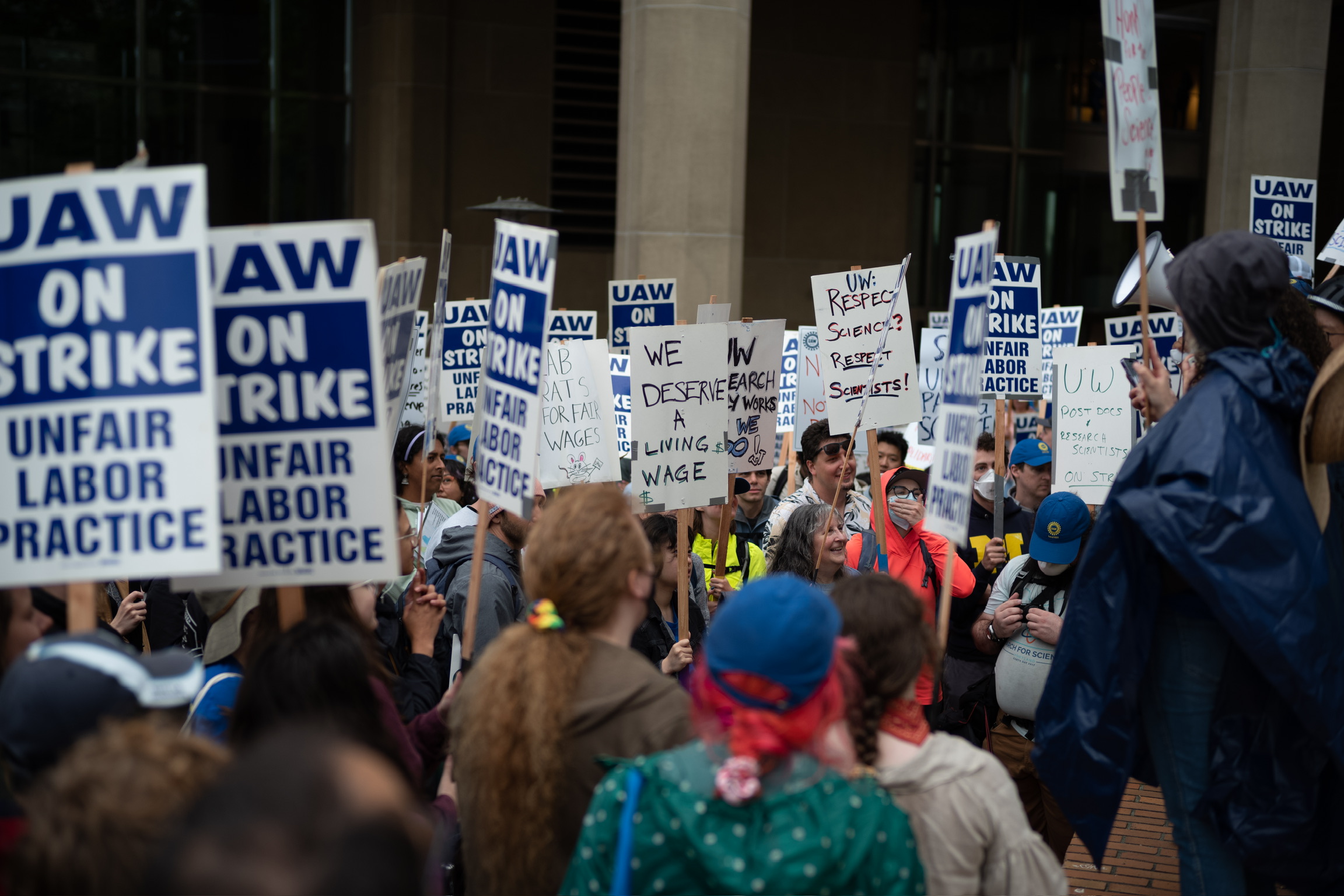
Fair compensation
Our work powers SLU. Graduate student workers teach undergraduate courses as instructors and TAs, grade students’ assignments like papers and exams, perform experiments and high caliber research, publish research papers, contribute to patents, help write research grants, support the administrative work of the university, and much more. The work that graduate student workers complete is integral to the operations, mission, and success of SLU.
Simply put, SLU would not be considered a top-tier university without our work.
And yet most of us struggle financially, lack basic benefits and face rent burden (defined as spending more than 30% of our monthly income on rent). Across the country, graduate workers have unionized and won benefits ranging from dental coverage, cost-of-living and wage increases, fee waivers, childcare, disability accommodations, guaranteed leave, international student assistance, and more.
With a union, we can work together to negotiate with SLU for higher pay for every graduate worker and keep SLU graduate programs competitive with peer institutions.
As academic employees throughout the country continue to form unions, we are raising the standards for “competitive pay” across the U.S.
Read more about UAW academic workers’ successful pushes for fair compensation:
The New York Times: N.Y.U. and Union Agree On Graduate-Student Pay
A stronger voice for international student workers
An estimated 40% of graduate workers at SLU are international and living in the US on student visas. International students can face multiple unique challenges. By unionizing, we can negotiate for greater legal and structural support. We can also seek greater workplace protections – like protection from unfair termination, abusive conduct, and unreasonable work expectations – that are especially impactful for the international student community. We can also create a community so that we don’t have to face problems alone and by doing so gain a stronger voice at SLU and in the national landscape.
With more than 100,000 academic workers across the U.S., including graduate employees, postdocs, research scientists, and non-tenure track faculty, UAW nationally and locally has become a leading voice advocating for expanded opportunities for international students. By joining together, international graduate workers have a stronger voice to advocate for policies like increased access to OPT and opposing limits on international student visas.
Read more about how UAW academic workers are advancing rights for international workers:
Op-Ed: Why International Grad Student Workers Support GSWOC-UAW
UW Daily: UAW 4121 stands up against new Trump ruling that limits the visas of international students and scholars
Columbia Spectator: UAW is a strong ally for international students and postdocs
UAW 5810: Resolution To Mt. Sinai Postdocs on International Researcher Rights
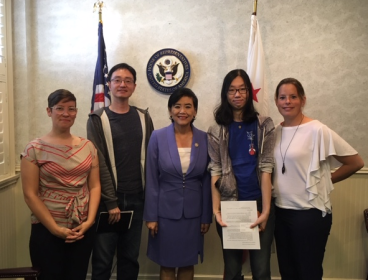
UAW Local 2865 and UAW 5810 union members with Congresswoman Judy Chu discussing her Dear Colleague Letter in support of Chinese international students at her office in Pasadena, 2018.

Joining UAW and a Movement in Higher Education
Over 100,000 academic employees across the U.S. have already chosen to join UAW. This includes Postdocs at Mount Sinai; Student Workers and Postdoctoral Researchers at Columbia University; Graduate Employees at New York University; Student Workers at The New School; Harvard Graduate Employees, University of California Academic Student Employees, Student Researchers, Postdocs, and Academic Researchers; and many more.
In just the past few years, Research Scientists and Engineers at UW voted 85% in favor of unionizing with UAW, Mount Sinai Postdoctoral Researchers voted 89.5% in favor of unionizing with UAW, and Worcester Polytechnic Institute Grad Employees voted 96% in favor of unionizing with UAW. And at other universities, including at Caltech, additional academic employees are also working toward joining UAW. By uniting together, academic employees are driving up standards in higher education and building a powerful voice for grad workers, postdocs, research scientists, and non-tenure track faculty.
Read more about our growing movement:
Los Angeles Time: UC strike energizes unprecedented national surge of union organizing by academic workers
WE’RE VOTING YES
On Wednesday November 13th and Thursday November14th, we will have the opportunity to vote “UNION YES” for the Graduate Workers of Saint Louis University Union UAW (GWSLU-Union UAW). In doing so, we would join tens of thousands of unionized academic workers across the U.S., including many workers at other Jesuit and religious higher education institutions. Through unionizing, we will create a more equitable, inclusive, and fair academic community, one that truly lives up to SLU’s principle of cura personalis, care for the whole person.
As graduate workers, we are proud to play a critical role in driving the high quality research and teaching conducted at SLU. However, without collective bargaining, SLU failed to make adequate stipend adjustments for twelve years, keeping graduate workers below a living wage. Additionally, we face a lack of clear protections from excessive workload and unfair treatment, inadequate benefits, and insufficient support for international graduate workers. Being a SLU graduate worker has become a stressful experience for many of us, which hinders our ability to focus on the quality research and teaching that has made SLU into a world-class institution.
If a majority of us vote “yes” for GWSLUUnion-UAW as our union, the SLU administration would be legally obligated to bargain with us graduate workers as equals over salaries, benefits, and workplace rights. These agreements would become a binding contract. As a unionized graduate work force, we will have a voice and power in decisions that directly impact us. Across the country, graduate workers have unionized and won benefits ranging from dental coverage, cost-of-living and wage increases, fee waivers, childcare, disability accommodations, guaranteed leave, international student assistance, and more. By unionizing here, we would help make SLU a better place for graduate workers to research, teach, and study, regardless of background.
Therefore, we urge you and all our colleagues to vote ‘YES’ for GWSLUUnion-UAW as our union, so that we have the strongest possible mandate to bargain with SLU administration for a fair union contract that improves our working conditions and lives
Abner Chacon, History
Ari Hutchinson, English
Ahlam Jaber, English
Alyssa Coleman, Public Health
Amy Broadway, Healthcare Ethics
Ángel Flores Fontánez, History
Angelina Ellis, Chemistry
Ashley Yukihiro, Healthcare Ethics
Benjamin Conover, Philosophy
Caleb Mundle, Theological Studies
Carly Finegan-Dronchi, Earth and Atmospheric Sciences
Carrie Burnett, Psychology
Celia McGhiey, Chemistry
Charles Freiberg, Philosophy
Colleen Bocke, Pharmacology and Physiology
Dari Gomez, Biology
Eileen Schaub, Biology
Elisabeth DeMarco, Health and Clinical Outcomes Research
Emily Quartarone, American Studies
Gabriela Soltys, Biology
Giuliana Piccione, American Studies
Glauber Wisniewski, History
Grace Wang, Education
Hannah Shanks, Social Work
Jaclyn Whalen, Biochemistry and Molecular Biology
Jacob Zimbelman, Philosophy
Jake Little, Aerospace and Mechanical Engineering
Jamshid Tadiwala, Biomedical Engineering
Jewell Dehon, Psychology
Katey Hunt, Molecular Microbiology and Immunology
Lily McMorrow, Health and Clinical Outcomes Research
Madison Veres, Psychology
Mindi Allison, Public Health
Natalie Hernandez, Earth and Atmospheric Sciences
Nate Bolin, Mathematics and Statistics
Nicolas Dumaire, Pharmacology and Physiology
Nicole Fuhler, Public Health
Peijun Hou, Computer Science
Rebecca Stokem, American Studies
Ryan Powers, Philosophy
Sai Kiran Ramanujam, Public Health
Salvatore DiBono, English
Sebastian Arteaga, Chemistry
Siobhan Perry, Earth and Atmospheric Sciences
Vanessa Reger, American Studies
Zackary Davis, American Studies